

What February 2026 Means for O‘ahu Buyers and Sellers
What February 2026 Means for O‘ahu Buyers and Sellers
February is often one of the quieter months in real estate, so it can be tempting to overreact to a single headline number, especially the median price. But February 2026 on O‘ahu is a good example of why context matters. Overall sales activity stayed steady, prices edged up modestly year over year, and the market continued to show a clear split: single-family homes are moving quickly with tighter supply, while condos are taking longer and offering a bit more breathing room for buyers.
Below is a plain-English breakdown of what the latest Honolulu Board of REALTORS® February 2026 Monthly Statistics Report suggests, and what it could mean if you are thinking about buying or selling this spring.
The big picture: stable activity, modest price growth
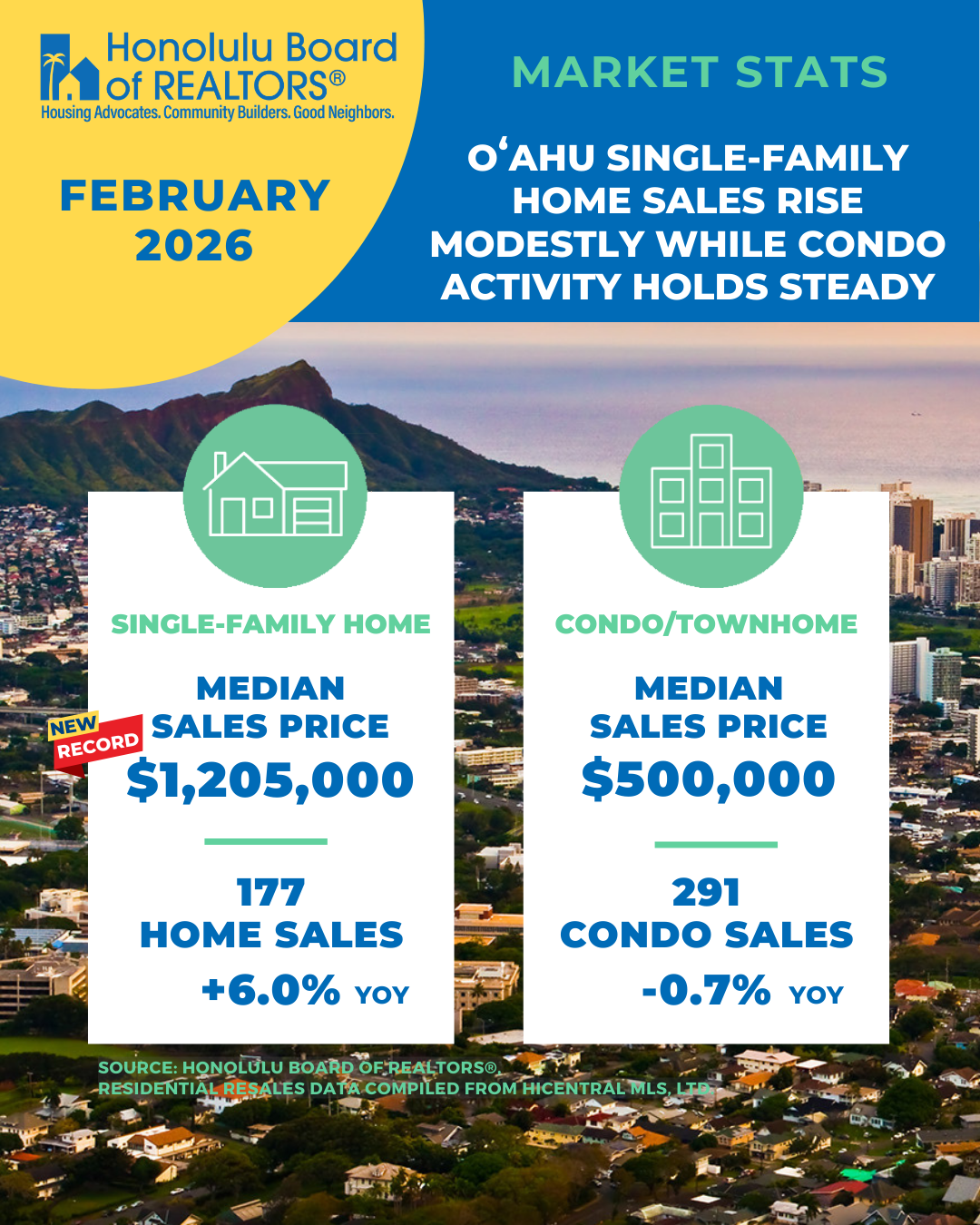
In February, single-family home sales increased while condo sales were essentially flat compared to last year:
Single-family closed sales: 177 (up 6.0% year over year)
Condo closed sales: 291 (down 0.7% year over year)
Prices also moved up slightly from February 2025:
Single-family median price: $1,205,000 (up 1.7% year over year)
Condo median price: $500,000 (up 1.2% year over year)
One important nuance: the median price reflects the mix of homes that sold that month. Honolulu Board of REALTORS® President Aaron Tangonan put it well: “February’s median price reflects the mix of homes that sold during the month rather than a sudden shift in market conditions.” In other words, if more higher-priced homes sell in a given month, the median can rise even if the underlying market has not dramatically changed.
Single-family homes: faster pace, tighter supply
If you have been watching the single-family market, the February numbers reinforce what many buyers and sellers have been feeling: it is still competitive in a lot of neighborhoods.
Homes are selling faster
The median days on market for single-family homes was 17 days, down from 23 days last February. That is a meaningful shift in pace, and it usually shows up in the real world as:
Fewer “wait and see” listings
More urgency around well-priced homes
Tighter windows for buyers to schedule showings and make decisions
Inventory is lower than last year
At the end of February, there were 673 active single-family listings, which is 7.6% lower than February 2025. Months of supply was 2.8 (down from 3.1), which is still a relatively tight environment.
For sellers, that generally supports pricing, but only when the home is positioned correctly.
For buyers, it means the best homes can still move quickly, and preparation matters (financing, timelines, and clarity on must-haves versus nice-to-haves).
The higher end helped lift the median
The report also notes increased sales activity at higher price points, including growth in ranges like $500,000 to $999,999, plus notable increases in luxury segments such as $1.2M to $1.299M and $1.9M+. When more high-end homes close in a month, it can push the median upward, even if entry-level conditions have not changed much.
Condos: more supply, longer timelines
The condo market is telling a different story. It is not “bad,” it is just behaving more like a market where buyers have options.
Condos are taking longer to sell
The median days on market for condos was 56 days, up from 48 days last February. That is a sign that buyers are taking more time, comparing choices, and negotiating.
Inventory is higher than last year
Condo active inventory ended February at 2,276 listings, up 5.4% year over year. Months of supply was 6.2 (up from 5.8).
In practical terms, that can mean:
More listings to choose from
More price reductions on stale inventory
More leverage for buyers, especially on units that have been sitting
Where the condo softness showed up
The report calls out that the largest decline in condo sales occurred in the $400,000 to $599,999 range (from 97 to 81 units, down 16.5%). That is a useful reminder that the condo market is not one single market. It can vary a lot by building, maintenance fees, financing eligibility, and price band.
What this means if you are buying on O‘ahu
If you are buying a single-family home
Expect speed and competition on the best listings. A few practical takeaways:
If a home is priced well and checks the boxes, be ready to move quickly.
Strong offers are not always about the highest price. Terms and certainty matter.
If you are stretching into a higher price tier, pay attention to inventory trends in that band. Some luxury segments can behave differently.
If you are buying a condo
You may have more room to negotiate, especially if:
The unit has been on market longer than the median
There are multiple similar units in the building
The seller is timing-sensitive
Condo buyers should also be extra mindful of the building-level details (HOA financials, insurance, special assessments, and financing guidelines), because those factors can matter as much as the market stats.
What this means if you are selling on O‘ahu
If you are selling a single-family home
The faster pace and tighter inventory are supportive, but buyers are still value-conscious. To take advantage of the market:
Price strategically based on recent comparable sales (not just active listings).
Make the first 7 to 10 days count. Photos, staging, and showing access matter.
Be prepared for buyers to compare your home to newer or renovated options. Condition still drives results.
If you are selling a condo
You are likely competing with more inventory, so positioning becomes even more important. A few seller strategies that tend to help:
Make sure your pricing reflects current competition in your building.
Highlight what makes your unit different (view, parking, upgrades, lanai, in-unit laundry, etc.).
Consider pre-listing improvements that reduce buyer objections (simple paint, lighting, deep clean, minor repairs).
One more stat that helps set expectations: over-asking sales
The portion of sales closing above the original asking price was unchanged from last year:
25% of single-family sales closed above original asking price
10% of condo sales closed above original asking price
This is a helpful reality check. Even in a faster single-family market, most homes are still closing at or below list price, which means pricing and negotiation strategy matter on both sides.
Want the “what does this mean for my neighborhood?” version?
Market-wide stats are a great compass, but they do not replace neighborhood-level and building-level trends. If you tell me what area you are focused on (and whether you are buying or selling), I can share a quick, practical read on:
Recent comparable sales
Current competition (active listings)
Realistic timing and pricing expectations
What buyers are responding to right now
Mahalo, Mai
Mai Homes
mai@maihomeshi.com
(808)782-0072
REALTOR RS-84287
powered by eXp Realty
