

HARPTA and FIRPTA in Hawaii: What Sellers, Buyers, and Investors Need to Know
If you are selling a property in Hawaii — or buying from someone who does not live here — you may hear the words HARPTA and FIRPTA come up. Most people's eyes glaze over at this point, but these rules have real money attached to them, and understanding them early can save you from a stressful surprise at closing.
Here is an explanation of what they are, who they affect, and what you can do about them.
What Is HARPTA?
HARPTA stands for the Hawaii Real Property Tax Act. It is a Hawaii state law that requires withholding a portion of the sale proceeds when a seller is not a Hawaii resident at the time of the sale.
The purpose is to make sure the state collects any capital gains taxes owed by out-of-state sellers, who might otherwise sell a Hawaii property and leave without filing a Hawaii tax return.
HARPTA Withholding Rate
Under current rules, the withholding amount is 7.25% of the total purchase price — not the profit, the entire sales price.
On a $700,000 sale, that is $50,750 withheld at closing. The escrow company holds it and sends it to the state.
Who Does HARPTA Apply To?
HARPTA applies to sellers who are not Hawaii residents at the time of closing. This includes:
Sellers who moved to the mainland after owning a Hawaii property
Mainland investors who own rental properties here
Anyone who does not currently live in Hawaii as their primary residence
Who Is Exempt from HARPTA?
If you are a Hawaii resident (you live here as your primary residence), you are generally exempt from HARPTA withholding.
If the sales price is $600,000 or less and the buyer signs an affidavit stating they intend to use the property as their principal residence, the HARPTA withholding may also be reduced or eliminated.
Can a Non-Resident Seller Get That Money Back?
Yes. The withholding is not a final tax — it is a deposit against what you may owe. After you file your Hawaii state tax return, any amount withheld beyond your actual tax liability is refunded. If you had little or no gain on the property, most or all of it may come back to you.
You can also apply for a withholding certificate from the Hawaii Department of Taxation before closing to reduce the withheld amount if your actual gain is lower than the withholding would suggest. This requires documentation and should be started well before your closing date.
What Is FIRPTA?
FIRPTA stands for the Foreign Investment in Real Property Tax Act. It is a federal law — not Hawaii-specific — that applies when the seller is a foreign person (not a U.S. citizen or permanent resident) who is selling U.S. real estate.
FIRPTA withholding is collected by the buyer's escrow or closing agent and sent to the IRS.
FIRPTA Withholding Rate
The standard withholding rate is 15% of the purchase price. For lower-value properties where the buyer intends to use the property as a primary residence:
Properties sold for $300,000 or less: Potentially exempt if buyer uses as primary residence
Properties sold for $300,001–$1,000,000: Withholding can be reduced to 10% with buyer's use affidavit
Properties over $1,000,000: Full 15% withheld
Who Does FIRPTA Apply To?
FIRPTA applies when the seller is a "foreign person" — meaning:
Foreign nationals who own U.S. property (including vacation homes or investment properties)
Non-resident aliens
Foreign corporations, partnerships, or trusts that own U.S. real estate
Why This Matters for Hawaii Specifically
Hawaii has a significant number of properties owned by Japanese nationals, buyers from other parts of Asia, and Canadians who purchased vacation or investment property here. If you are one of them and you are thinking about selling, FIRPTA withholding will apply — and it can be a large amount.
The good news is that, like HARPTA, FIRPTA withholding is not a final tax. You file a U.S. tax return, report your actual gain, and receive a refund of any amount withheld beyond your liability. You can also apply for a withholding certificate from the IRS before closing to reduce the amount.
HARPTA + FIRPTA: Can Both Apply at the Same Time?
Yes. If you are a foreign seller (non-U.S. citizen/resident) selling a Hawaii property, both HARPTA and FIRPTA can apply simultaneously. That means:
7.25% withheld under HARPTA for the state
15% withheld under FIRPTA for the federal government
On a $700,000 sale, you are looking at roughly $50,750 (HARPTA) + $105,000 (FIRPTA) = over $155,000 withheld at closing — all refundable against your actual tax liability, but you need to file to get it back.
This is why foreign investors who own Hawaii real estate need to plan ahead. Working with a tax advisor or attorney who handles real estate transactions is strongly recommended.
What Buyers Need to Know
If you are the buyer, you are not paying HARPTA or FIRPTA — but you are legally responsible for making sure the withholding happens at closing when it applies. Your escrow officer will handle this, but it is something your agent should flag early, especially if:
The seller's address is out of state
The seller has a foreign address or is a foreign entity
The deal seems straightforward but the seller is slow to provide residency documentation
Missing HARPTA or FIRPTA compliance at closing can create complications, so having an experienced agent and escrow team matters.
Summary: HARPTA vs. FIRPTA Side by Side
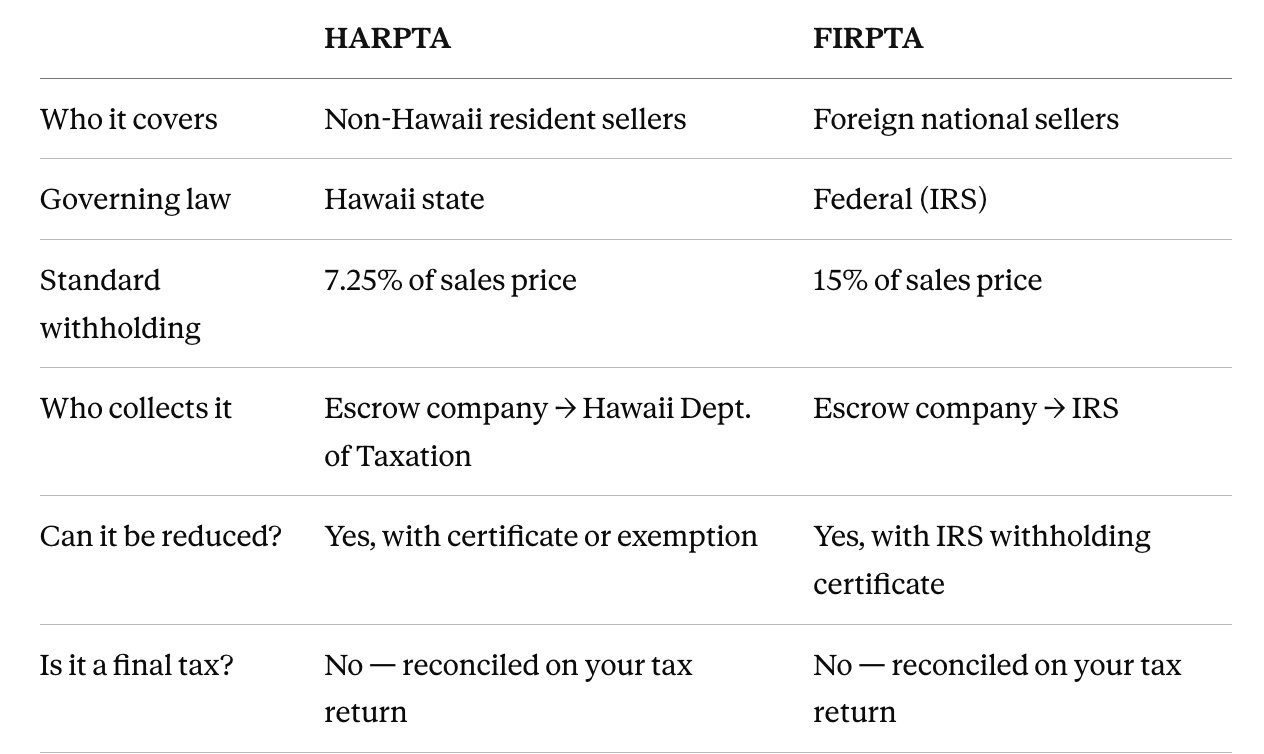
HARPTA vs. FIRPTA Side by Side
Questions About Selling in Hawaii as a Non-Resident or Foreign Owner?
This is one of the areas where working with a knowledgeable local agent — and connecting with a qualified tax professional early — makes a real difference. I work with sellers navigating this regularly, and I can refer you to trusted professionals who handle HARPTA and FIRPTA filings in Hawaii.
If you are thinking about selling your Hawaii property, let's talk through the timeline and what to expect.
Book a free consultation here: https://calendar.app.google/t6rYohGho6b7d5mbA
Note: This post is for general informational purposes only and is not tax or legal advice. Always consult a licensed tax professional or attorney for guidance specific to your situation.
Related reading:
